
Mixed agricultural property with residential and leisure amenities
Agricultural infrastructure, countryside living and flexible future uses
Ref. no. L00730LT:
Operational agricultural business in Lithuania, suitable for arable farming and livestock production, with approximately 180 hectares of owned arable land and 60 hectares of leased arable land.
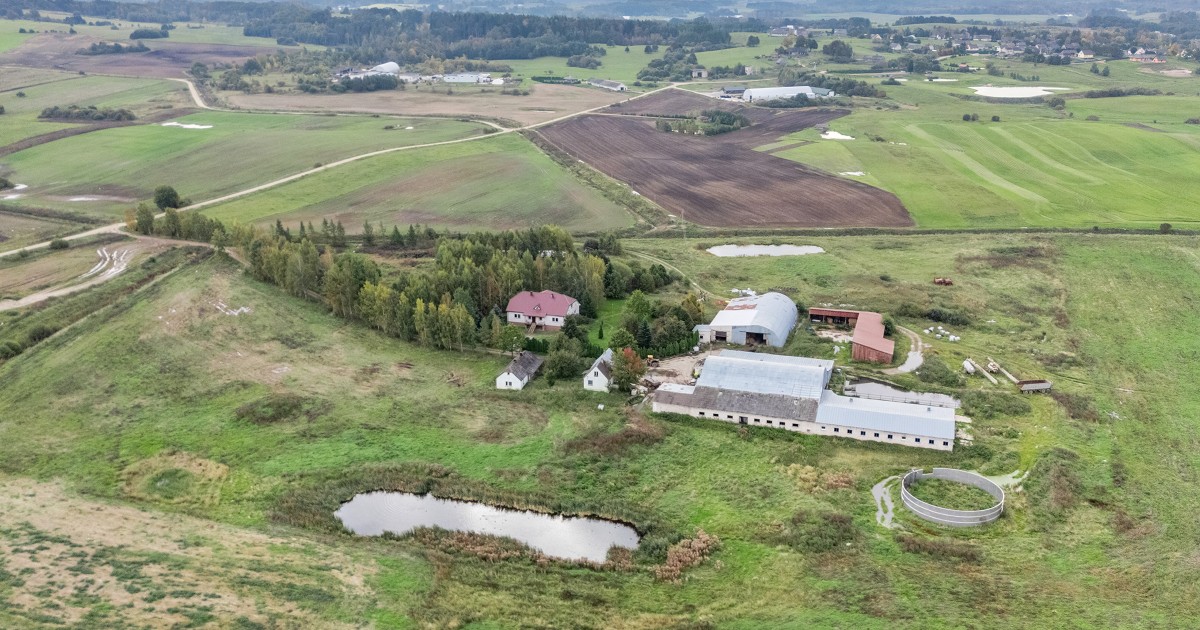
The farm is suitable for both arable and livestock farming and includes various agricultural buildings, including a cattle barn and machinery storage.
25 hectares approved for development.
The property also features an attractive residential and recreational area.
Flexible type of transaction: Share sale or asset sale.
Highlights:
- Mixed agricultural holding with 240-hectare land portfolio in Lithuania.
- Approximately 180 hectares of owned arable agricultural land for crop and forage activities.
- Approximately 60 hectares of leased arable agricultural land.
- 25 hectares approved for development, offering attractive opportunities for development of e.g. cattle, pig, poultry production etc.
- Cattle facilities for approximately 100 head.
- Agricultural building, machinery storage and various outbuildings.
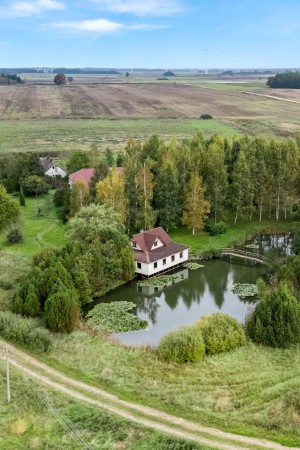
- Three residential buildings, including a main house of approximately 300 m².
- Four ponds, a sauna with jetty and waterside facilities complement the farming setting.
- Peaceful and very private location.
- Room for development and expansion. There is an opportunity to purchase or lease more land in the area.
A working farm with more than one direction.
Explore a mixed agricultural holding in western Lithuania, combining approximately 240 hectares in the wider land portfolio with around 180 hectares of owned and around 60 hectares leased agricultural land. Existing farm infrastructure includes cattle accommodation, machinery storage and other agricultural buildings. The residential setting adds another dimension, with three houses, four ponds and a sauna beside the water.
Farming, countryside and room for development.
Arable and forage production can be considered alongside the existing livestock facilities, although livestock was sold in 2024. The combination of farm buildings, accommodation and waterside amenities also invites consideration of rural hospitality, equestrian activities or countryside recreation, subject to the necessary planning, operational and regulatory checks.
With approximately 25 hectares approved for development adjacent to the existing building site, the property offers attractive opportunities for development of e.g. cattle, pig, poultry production etc.
Jesper Kjær ApS coordinates investor enquiries, further presentations and property visits.

A Lithuanian agricultural opportunity
Lithuania combines an established farming tradition with access to the European Union’s agricultural market. For investors seeking a real agricultural operating base rather than an undeveloped land parcel, the combination of land, buildings and residential facilities deserves particular attention. This property brings together productive agricultural use and an attractive rural setting, creating a proposition that can be assessed from several perspectives: continuing field operations, restarting selected livestock activities, or developing complementary countryside uses. Each direction requires its own business plan, but the existing physical infrastructure gives prospective purchasers a starting point for detailed due diligence.
Agriculture within the Lithuanian economy
Agriculture remains an important element of Lithuania’s rural economy. The European Commission’s overview of the Lithuanian Common Agricultural Policy Strategic Plan reports approximately 150,300 agricultural holdings and indicates that about 45% of the country’s area is used for agriculture. Those national figures describe the wider market, not the size or performance of this particular holding. They nevertheless underline the depth of the agricultural landscape in which a purchaser would operate. Lithuania’s farms range from small family enterprises to larger, specialised operations, and successful management depends on field organisation, machinery, input costs, labour and access to markets.
Agricultural policy and investment context
Lithuania implements the EU Common Agricultural Policy through its 2023–2027 Strategic Plan. The plan addresses agricultural competitiveness, farm viability, environmental performance, innovation and rural development. The Lithuanian National Paying Agency explains that support instruments span direct payments, environmental measures and selected rural investment programmes. Eligibility is never automatic: it depends on the applicant, the land, the activity, applicable commitments and the rules in force when an application is submitted. A purchaser should therefore assess any potential support separately from the acquisition price and should not treat historical payments to the existing business as a forecast of future receipts.
Land, cultivation and operational choices
The information supplied for this holding identifies approximately 240 hectares in the overall land portfolio, including around 180 hectares of privately owned agricultural land and 60 hectares of rented land. The current main crops are wheat, oilseed rape, maize for silage and grain, grass for silage, lucerne for silage, and soya beans.
Existing infrastructure for mixed farming
A notable part of the proposition is the agricultural building complex. The farm includes cattle facilities originally described as accommodating approximately 100 head, together with a substantial agricultural building, machinery storage and ancillary structures. Accordingly, this should be viewed as a property with livestock infrastructure, not as a sale of an active cattle herd.
Agriculture in a rural setting with room for development
This agricultural property combines a rural setting with attractive opportunities to expand and develop operations. Additional farmland is available to purchase or lease in the immediate vicinity, offering scope to increase crop production. Approximately 25 hectares of land approved for development and located immediately adjacent to the existing buildings offer potential for cattle, pig or poultry farming, subject to obtaining the necessary approvals for the proposed operations. The combination of existing buildings, adjoining development land and access to additional farmland makes the property an attractive proposition for buyers with long-term ambitions in agriculture.
Residential setting and recreational appeal
Beyond the productive farmyard, the holding offers an unusually varied residential and leisure environment. The seller identifies three residential buildings, including a completed principal residence of approximately 300 square metres. There are four ponds of around half a hectare each, two reportedly stocked with fish, together with a sauna, jetty and waterside relaxation area. These features may be particularly appealing to a purchaser seeking a rural home alongside a working agricultural enterprise. There may be potential for commercial guest accommodation, organised activities or paid recreation, subject to the necessary approvals.
Possible equestrian and countryside uses
The presence of agricultural buildings, land and accommodation makes equestrian use or small-scale rural tourism worth exploring as possible complementary activities. Existing livestock buildings might, following a technical assessment and any required alterations, be adaptable to other animal-related uses. Grassland and field access could be relevant to grazing or riding arrangements. Equally, the ponds and residential buildings could form part of a countryside hospitality concept if planning and operating conditions allow it. None of these potential uses should be mistaken for an existing authorised business, and no income from them is assumed. Their attraction lies in the opportunity to test a diversified strategy against the actual property and local demand.
The landscape of western Lithuania
The wider Telšiai area belongs to Lithuania’s Žemaitija, or Samogitia, cultural and landscape region, known for a mosaic of farmland, woodland, lakes and gently rolling countryside. The Lithuanian State Service for Protected Areas describes Žemaitija National Park as a landscape of wooded terrain and lakes, including the Lake Plateliai complex. This is regional context rather than a claim that the farm lies within the national park. For a buyer interested in countryside living, the broader setting adds to the appeal of combining an agricultural enterprise with nature-oriented activities. Any nature or tourism concept would still need to be tested against the exact site and relevant local restrictions.
Accessibility and day-to-day management
The farm is located only a few kilometres from the town of Telšiai and around two kilometres from a main road. That proximity offers a practical point of reference for planning supplies, staff travel and property visits, while the countryside setting retains the privacy described in the sales correspondence. The fields are located around the farmyard and are worth inspecting.
Transaction structure and investor due diligence
The supplied information indicates that a share sale or an asset sale may be considered. These are materially different transaction routes, with different implications for liabilities, land title, contracts, taxation and completion procedures. The company is identified as a Lithuanian private limited liability company. Any investor should commission independent legal, accounting, technical and environmental reviews and reconcile the land register, tenancy agreements, building records, machinery inventory and financial statements. Acquisition by a foreign investor may be subject to Lithuanian land-acquisition rules and purchaser-specific conditions.
An invitation to explore the possibilities
This is an opportunity to examine a diversified countryside asset: farmland and cultivation, buildings for agricultural use, residential accommodation and waterside amenities in one proposition. The most appropriate future configuration will depend on the buyer’s experience, resources and commercial objectives. Some investors may prioritise agricultural production; others may consider a mixed model that incorporates leisure or equestrian activity over time. Jesper Kjær ApS acts as an independent intermediary, working with local contacts to coordinate enquiries, additional documentation and viewings. Interested parties are invited to request further information and arrange a structured discussion of the property and transaction.
Have you not yet found the right property?
If the property shown is not exactly what you are looking for, we would like to hear from you, as we have a number of properties in preparation that have not yet been published online.
Most transactions take place as discreet sales, so it is a good idea to be registered in our database, whether you are a buyer or a seller.
Frequently Asked Questions
about agricultural, forestry and nature investments in Central and Eastern Europe
What is Jesper Kjær ApS, its business and when was it established?
Jesper Kjær ApS is an independent development and brokerage firm that has facilitated investment projects in Poland, Lithuania, Latvia, and Estonia since 2001, with a particular focus on agriculture and forestry since 2003. As of 2024, we have expanded our activities to include the Czech Republic and as of 2026 also Slovakia.
What services does Jesper Kjær ApS provide?
We identify investment opportunities and guide investors through the complex process of acquiring the desired business.
What is the purpose of Jesper Kjær ApS?
The purpose of the company is advisory services in connection with investments in agricultural and forestry land, as well as agricultural and forestry businesses abroad, including the brokerage of such land and businesses.
How has the company’s international experience evolved?
Through more than two decades of developing and mediating investment projects in Europe and North Africa, the company has grown its skills, step-by-step, in cooperation with a large, effective network.
What types of agricultural businesses are typically offered for sale via Jesper Kjær ApS?
Arable farms, mixed crop/livestock operations, dairy farms, pig farms, poultry farms, and large-scale land portfolios.
What specialized agricultural projects are offered?
We facilitate everything from arable land and dairy farms to specialized projects in beef production, pig farming, poultry farming, biogas plants, etc.
How is soil quality assessed on the properties?
Domestic classification systems provide investors with an accurate picture of the soil quality and cultivation potential.
What is the typical size and price range of agricultural farms offered via Jesper Kjær ApS?
Investments typically cover 400 to 3,000 hectares of land, resulting in transactions worth several million euros, depending on soil quality and infrastructure.
How is agricultural land ownership structured?
Acquisition is often structured in a company structure consisting of new and/or existing special purpose companies. Acquisitions may include direct freehold ownership, long-term lease agreements, or a combination of both.
In which countries does Jesper Kjær ApS broker forestry properties?
We broker forestry properties in Lithuania, Latvia and Estonia.
What characterises the Baltic forests?
The Baltic Forest is a lush, sprawling transition zone where the temperate leafy woods of Central Europe meet the rugged, evergreen taiga of the North. Spanning Estonia, Latvia, and Lithuania, these forests are the lifeblood of the region, covering roughly 50% of the land.
What is the ecosystem of the Baltic forests like?
The Baltic states sit in a botanical 'sweet spot' called the hemiboreal zone. This means you get the best (and most resilient) of both worlds: Conifers: Scots pine and Norway spruce dominate, especially in sandy soils or coastal areas. Broadleaf Trees: Birch, aspen, and alder are everywhere, providing a brilliant yellow hue in the autumn. The Giants: In more fertile pockets, you’ll find 'noble' hardwoods like oak, ash, and lime trees.
What roles do land, water and moss play in the Baltic forests?
The nature of these forests is inseparable from water. Because the terrain is relatively flat, the drainage is slow, leading to a distinct landscape: Wet Forests: Large sections of the forest are 'swampy', dominated by black alder and thick carpets of sphagnum moss. The Forest-Bog Mosaic: You often can't tell where the forest ends and the peat bog begins. This high humidity creates a haven for rare lichens and fungi. Coastal Influence: Along the Baltic Sea, the forests become wind-swept and 'crooked', with pines adapted to salty air and sandy dunes.
What characterises biodiversity and wildlife in the Baltic forests?
Unlike much of Western Europe, the Baltic Forests remain relatively wild and interconnected, allowing large mammals to thrive.
What tree species are widespread in the Baltic countries?
Widespread species include Scots pine (Pinus sylvestris), Norway spruce (Picea abies) and silver birch (Betula pendula). In addition to birch, several other broadleaf species thrive in the temperate climate, including grey and black alder, European aspen, English oak and common ash.
How are Baltic forest properties structured?
The return of property to the original owners, after the restoration of the three Baltic nations in the 90s, has resulted in the average property size being small. It is considered by some investors as a disadvantage, while others see it as an advantage because its negotiability is better. The number of potential buyers is greater because the buyer's capital does not have to be so large with each transaction.
What types of forestry businesses are typically offered for sale via Jesper Kjær ApS?
Both small plots of, for example, 20-30 hectares and large portfolios of several hundred or thousands of hectares are offered for sale. We facilitate everything from small forest plots to large portfolios, including young forests, middle-aged forests and mature forests ready for harvest. We facilitate transactions involving production forests, naturally growing forests, nature conservation forests and nature or recreation areas, or a combination of these.
How is forestry land ownership typically structured?
Acquisition is often structured in a company structure consisting of new and/or existing special purpose companies.
What does it mean when a property is sold in a discreet transaction?
This means the sale is handled confidentially without public disclosure of details like the owner's identity until a non-disclosure agreement is in place.
Are off-market agricultural properties available?
Yes. Many transactions are conducted off-market and accessed through established local networks and long-term relationships.
Why is local knowledge emphasized for international investors?
Local understanding is critical for analyzing risks and opportunities when 'shopping abroad' in diverse European markets.
Can Jesper Kjær ApS help find a specific type of investment not currently listed?
Certainly. We offer a discreet market screening and search service to identify properties meeting your specific criteria.
What specific investment opportunity is being offered here?
The property offered under Jesper Kjær ApS reference L00730LT is a mixed agricultural property in Lithuania, with arable production and existing livestock facilities.
What are the main production and infrastructure features of reference number L00730LT?
A versatile Lithuanian farm with room for more than farming
Why may reference number L00730LT be relevant for investors seeking operating assets or development projects?
Agricultural buildings, accommodation, ponds and countryside appeal
How may a potential transaction of reference number L00730LT be structured?
A share sale or an asset sale may be considered.
How can potential investors contact Jesper Kjær ApS?
You can contact Jesper Kjær directly by telephone at +45 51361495 or by email at jk@jkaps.dk.